PEM Hardware Installation for Custom Metal Brackets
Engineers and procurement teams often face assembly bottlenecks caused by improperly installed hardware. A loose stud or a misaligned nut can stall an entire production line. At BracketMFG, we integrate PEM hardware installation directly into our bracket manufacturing workflow, ensuring your components arrive ready for final assembly.
We specialize in cold-pressed fasteners—including nuts, studs, and standoffs—that provide high pull-through and torque-out resistance in sheet metal.
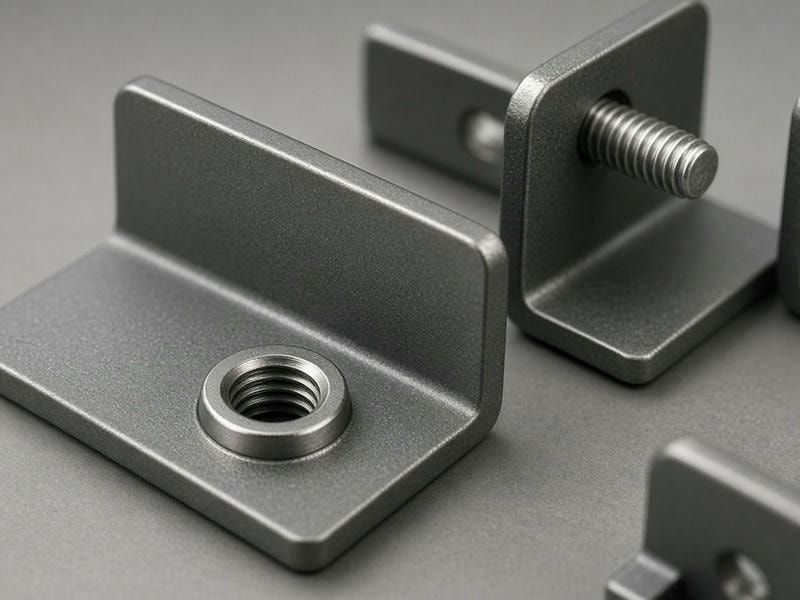
Integrated Hardware Installation
We do not treat hardware installation as an afterthought. Our production process embeds the insertion phase immediately following the bending and CNC punching stages. This ensures that the bracket geometry is already verified before the hardware is pressed into place.
Process Control
By controlling the material thickness, hole diameter, and pressing force, we ensure that the hardware sits flush and remains secure under the loads defined in your assembly specifications.
Reliable Assembly Alternative
We work with standard PEM-style self-clinching fasteners, providing a reliable alternative to welding or loose nuts in your assembly.
Our Manufacturing Capabilities
We maintain dedicated stations for hardware insertion to avoid cross-contamination and ensure consistent force application. Our shop floor is equipped to handle a wide range of fastener types across various material thicknesses.
Fastener Types
Self-clinching nuts, flush-head studs, standoffs, pins, and panel fasteners.
Material Compatibility
Cold-rolled steel, stainless steel (304/316), aluminum (5052/6061), and galvanized steel.
Precision Control
Operators monitor pressing depth and force to prevent material deformation around the insertion point, critical for flatness and assembly tolerances.
Quality Assurance
Every batch undergoes pull-out and torque-out testing to verify mechanical requirements specified in your technical drawings.
Technical Specifications
The following table outlines our standard capabilities for hardware installation. If your project requires hardware outside these parameters, please include the manufacturer’s datasheet with your RFQ.
| Specification | Typical Capability |
|---|---|
| Supported Hardware Sizes | M2 – M10 |
| Fastener Types | Nuts, Studs, Standoffs, Pins |
| Min. Material Thickness | 0.5 mm (dependent on fastener type) |
| Max. Material Thickness | 12 mm |
| Insertion Tolerance | ±0.10 mm (hole-to-hole center) |
| Pressing Force | Up to 10 Tons |
| Pull-out Resistance | Verified per manufacturer spec |
| Surface Finish Compatibility | Powder coating, Zinc, Anodizing |
Design for Manufacturability (DFM) Support
Poorly placed hardware can lead to interference issues during assembly or structural weakness in the bracket. Before we begin production, our engineering team reviews your CAD files for the following:
- Edge Proximity: We ensure the fastener is placed far enough from the bend radius and the edge of the sheet to prevent material distortion.
- Hole Diameter: PEM hardware requires specific hole sizes to function correctly. We verify your hole patterns against the specific fastener manufacturer’s technical guidelines.
- Material Hardness: We check that the hardness of the bracket material is compatible with the fastener material to ensure the clinching process works as intended.
If we identify potential risks during the review, we will propose design adjustments to improve the mechanical integrity of the final assembly.
Scaling from Prototype to Production
We adjust our installation methods based on your production volume to optimize both cost and consistency.
Prototypes & Low Volume
We use manual or semi-automated presses. This allows for flexibility and quick turnarounds without the need for expensive custom tooling.
High Volume
For recurring orders, we utilize automated hardware insertion systems and custom fixtures. This reduces labor time, ensures 100% repeatability, and lowers the unit cost for your program.
Whether you need a single prototype for a test rig or 10,000 units for a production run, we maintain the same level of attention to installation quality.
Request a Quote
To receive a quote, please send your 3D files (STEP/STP) and 2D engineering drawings to .
Please ensure your drawings clearly indicate:
- 1 The specific PEM part numbers or manufacturer datasheets.
- 2 The required orientation and hole locations.
- 3 Any specific torque or pull-out requirements.
Our engineering team will review your files and provide a manufacturing plan tailored to your volume and technical specifications.
BracketMFG