Precision Countersinking for Custom Metal Brackets
Countersinking is a critical secondary operation for brackets requiring flush-mount hardware. When flat-head screws must sit perfectly level with the bracket surface to allow for mating components, proper countersink depth and angle control are essential.
BracketMFG provides precision countersinking integrated into our standard sheet metal fabrication workflow. We handle the process from initial prototype to high-volume production, ensuring your hardware fits correctly every time.
- Standard Angles
- 82° & 90°
- Materials
- Steel · Alu · Cu
- Workflow
- In-House
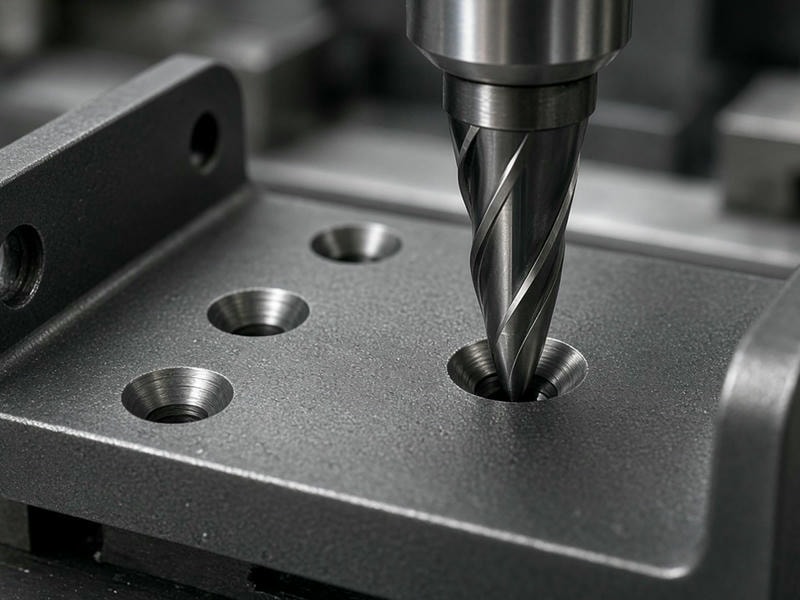
Our Countersinking Capabilities
We process countersinking in-house using CNC machining, punching, and specialized tooling. Our manufacturing approach prioritizes hole-to-edge distance and material integrity to prevent deformation.
Standard Angles
We accommodate industry-standard screw head angles, including 82° and 90°.
Material Compatibility
Our equipment is calibrated for carbon steel, stainless steel, aluminum, and copper.
Integrated Workflow
Countersinking is performed alongside laser cutting, bending, and PEM hardware installation. This reduces handling time and ensures tighter tolerance control across the entire part.
Tolerance Management
We verify countersink depth against your screw specifications to prevent knife-edging or insufficient depth where the screw head protrudes.
DFM and Engineering Support
A common issue with countersinking is attempting to apply it to materials that are too thin. If the material thickness is less than the required depth of the countersink, the structural integrity of the bracket is compromised.
When you submit your STEP, DXF, or PDF drawings to BracketMFG, our engineering team reviews your design for manufacturability (DFM).
Submit Drawings for Review-
1
Material Thickness Verification
We check if your specified material gauge supports the required countersink depth.
-
2
Hole Pattern Analysis
We ensure hole locations allow for sufficient edge distance to prevent material tearing during the countersinking process.
-
3
Alternative Recommendations
If your material is too thin for a standard countersink, we can recommend alternatives such as dimpling or installing specialized PEM fasteners to achieve a flush fit without sacrificing strength.
When to Specify Countersinking
Countersinking is recommended for applications where surface interference must be eliminated.
Electronics Enclosures
Where internal components must slide into place without catching on screw heads.
Robotics & Automation
Where brackets are mounted to moving parts that require a smooth, snag-free profile.
Automotive Assemblies
Where aesthetic finish and clearance are required for trim or structural mounting.
Data Center Racks
Where high-density mounting requires flat surfaces for modular installation.
If your project involves high-volume production, we evaluate whether to move from CNC-machined countersinks to stamped features. This transition can significantly reduce unit costs while maintaining the same assembly fit and finish.
Request a Quote
We review all drawings for countersinking feasibility before production begins. For accurate pricing and lead times, please provide your engineering files, material requirements, and hardware specifications.
Our team provides fast quoting and technical feedback to ensure your brackets are ready for assembly upon delivery.
- Send your drawings to
- Mailing Address
- Phone / WhatsApp
- ·